Product
August 9, 2026
Introducing Reverb Commerce: A Complete E-Commerce Platform for Bangladesh
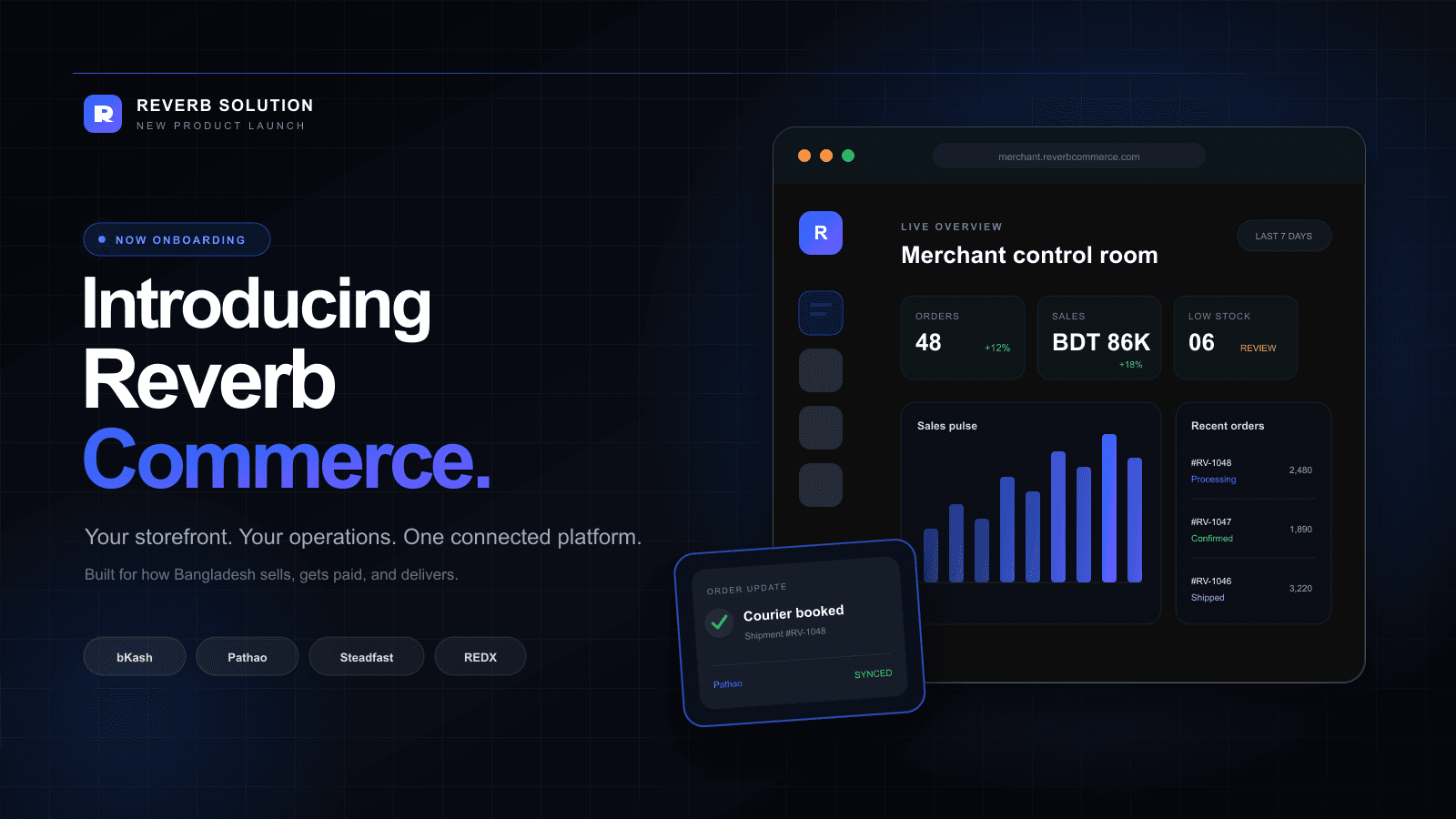
We Are Launching Reverb Commerce
Selling online should not require a business owner to operate five disconnected systems.
Yet that is still the normal experience for many growing businesses in Bangladesh. Products live in one tool. Orders arrive through another. Payments have to be checked separately. Courier bookings happen in a different portal. Stock is updated in a spreadsheet. Website content requires a developer. Reports are assembled by hand at the end of the week.
Every tool may work on its own, but the business around them does not feel connected.
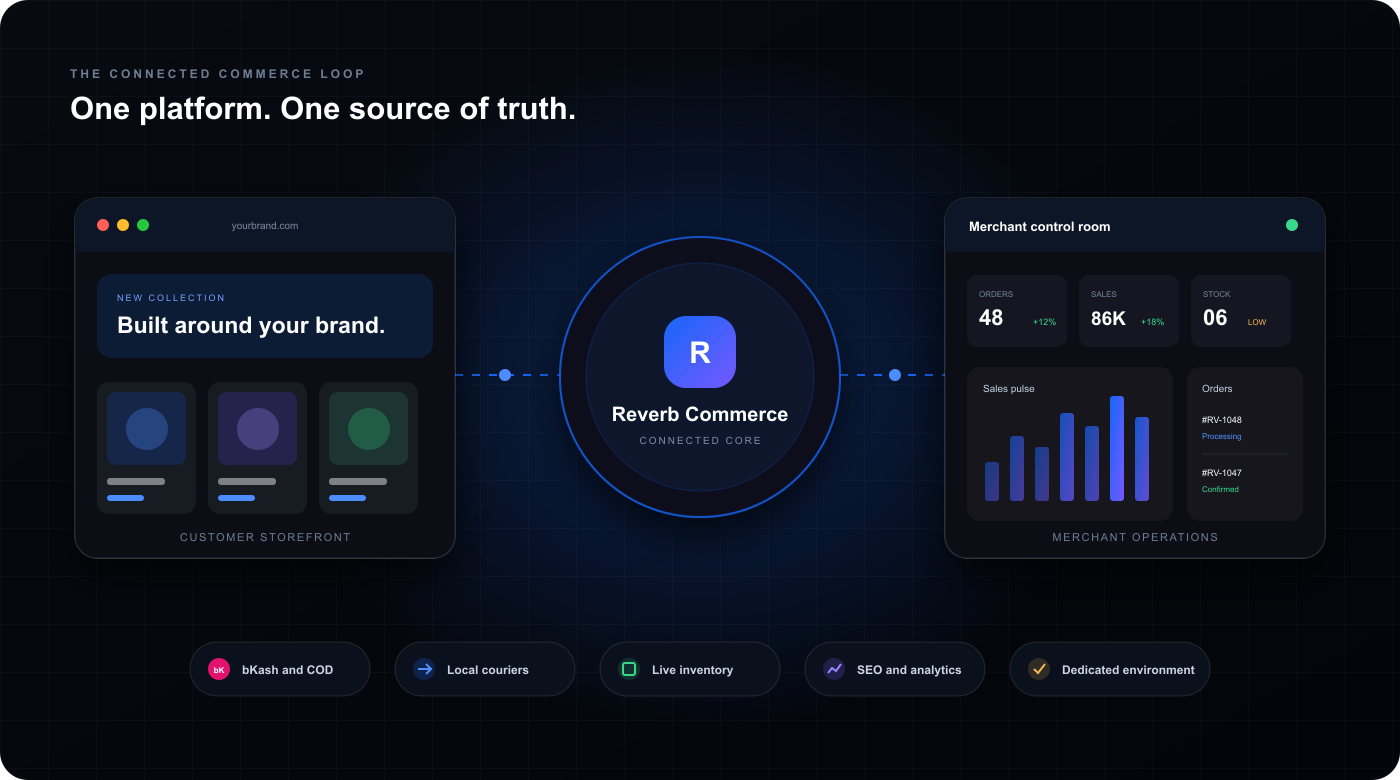
Today, we are introducing Reverb Commerce, a complete branded e-commerce storefront and merchant operations platform built by Reverb Solution. It connects the customer journey, from product discovery and checkout to payment, stock, delivery, and tracking, with the daily work happening behind the store.
This is not a marketplace profile and it is not a generic page template. It is a store for your brand, on your domain, with a merchant control room your team can use every day.
Explore Reverb Commerce or view live storefronts: VE Gear, MiniCo., and Kawaii.
Why We Built It
Bangladesh has a distinctive commerce workflow. Cash on Delivery remains essential. bKash is a familiar payment choice. Delivery often depends on local courier networks such as Pathao, Steadfast, and REDX. Businesses need different delivery pricing inside and outside Dhaka. Customers expect updates, while merchants need enough control to review an order before dispatch.
Many international platforms can be adapted to this environment, but adaptation often creates a long chain of plugins, manual steps, and recurring compromises. The storefront may look polished while operations behind it remain fragmented.
We designed Reverb Commerce around the full local journey instead:
- A shopper discovers a product on a fast, branded storefront.
- The shopper checks out as a guest using Cash on Delivery or bKash.
- The platform keeps the order, payment state, and inventory synchronized.
- The merchant reviews the order and books a local courier from the order screen.
- Courier events update the workflow and the public tracking experience.
- The merchant sees sales, stock, customers, and team activity in one dashboard.
The goal is simple: reduce the distance between receiving an order and delivering it successfully.
One Product, Two Connected Experiences
An e-commerce platform has two audiences, and both matter.
The first is the shopper. They need a store that is clear, trustworthy, responsive, easy to search, and easy to buy from.
The second is the merchant team. They need accurate stock, manageable orders, payment visibility, courier actions, customer records, content controls, and useful reports.
Reverb Commerce brings those experiences together. A catalog update in the merchant dashboard powers what customers see. An order placed on the storefront appears in the operations workflow. A courier update moves the order forward. There is no need to rebuild the same truth in several tools.
The customer-facing storefront
Every store is prepared around the business's own brand rather than a shared marketplace identity. The storefront includes:
- a branded domain and visual theme,
- responsive shopping across mobile and desktop,
- searchable products and category browsing,
- product variants such as size and color,
- stock-aware product availability,
- promotions and discount support,
- guest checkout,
- delivery options for local buying patterns,
- Cash on Delivery and bKash support,
- order confirmation and public tracking,
- clean URLs and product-level SEO information.
The storefront keeps the product at the center. Reverb Commerce provides the system underneath, but the customer sees and remembers the merchant's brand.
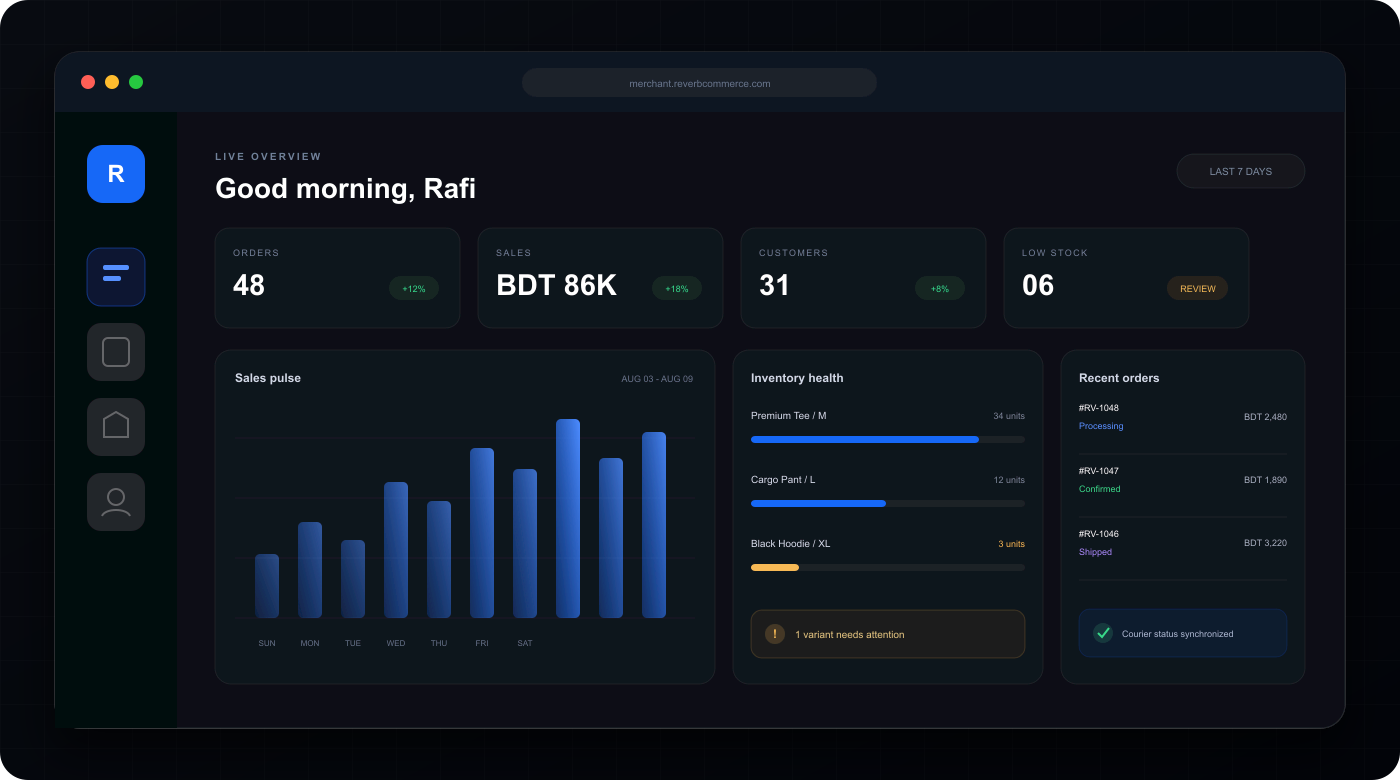
The merchant control room
Behind the storefront is a protected dashboard for the people operating the business. It brings together:
- product, category, variant, and inventory management,
- order review and status management,
- payment-state visibility,
- courier selection and shipment booking,
- customer records,
- low-stock visibility,
- sales and order reporting,
- invoices and operational records,
- content management,
- staff roles and access levels,
- audit history for important activity.
The dashboard is designed around attention. A merchant should be able to open it and understand what happened, what is moving, and what needs action now.
Payments That Match How Customers Buy
Checkout is where trust turns into revenue. It is also where a poorly connected system can create duplicate orders, incorrect stock, or uncertainty for both the customer and the merchant.
Reverb Commerce supports the two methods central to many online businesses in Bangladesh:
Cash on Delivery
Customers can place an order without creating an account or completing an online payment. The merchant receives the order in the dashboard, reviews it, and moves it into fulfillment.
bKash
Customers can select bKash during checkout and complete payment through the configured payment experience. Payment state remains connected to the order so the merchant does not have to reconcile an unrelated message with a separate order record.
The platform also treats inventory as part of the payment workflow. Stock is handled safely during an order and can be restored when a payment fails, reducing the risk that unavailable items remain blocked or that the store promises inventory it no longer has.
Payment gateway usage and other third-party charges are separate from the Reverb Commerce subscription.
Local Courier Operations, Inside the Order
For many stores, delivery work begins by copying customer information out of the order and entering it again in a courier portal. That repeated data entry takes time and creates opportunities for mistakes.
Reverb Commerce is designed to connect with Pathao, Steadfast, and REDX. From the merchant workflow, the team can approve an order, select an active courier, create the shipment, and follow its status.
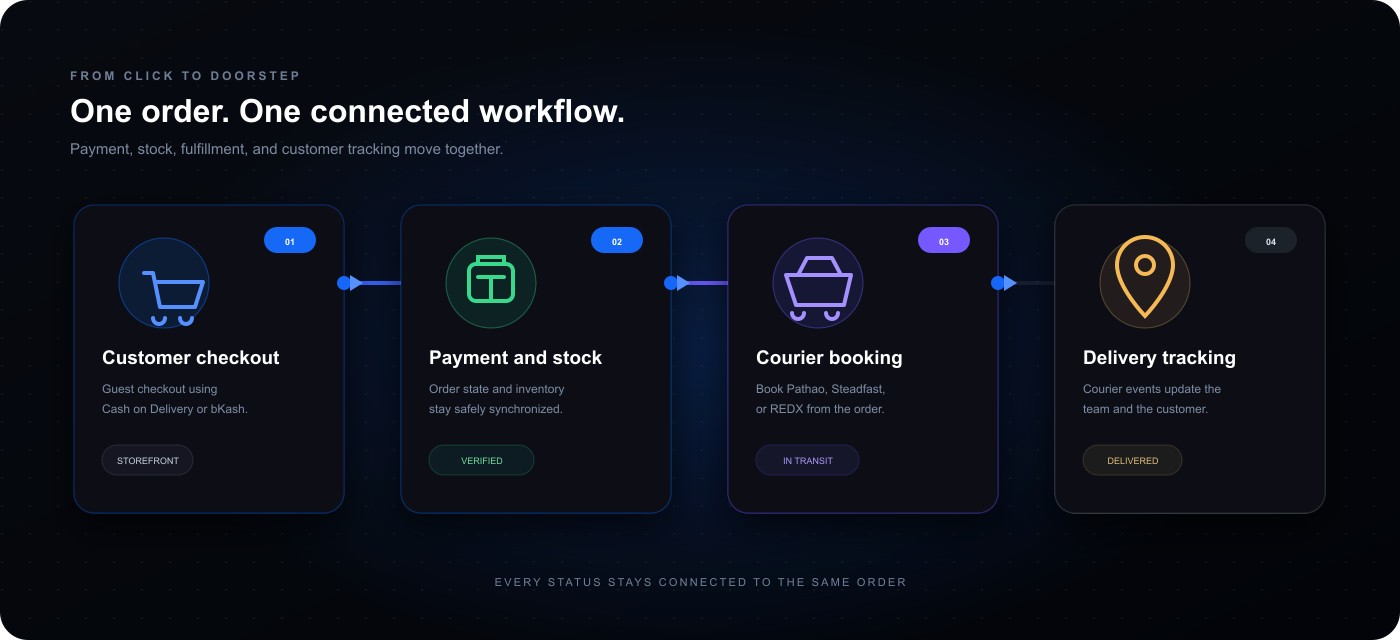
The connected flow is:
- customer places the order,
- payment and stock states are recorded,
- merchant confirms the order,
- shipment is booked with the selected courier,
- pickup and transit events move the order forward,
- the customer-facing tracking state stays current.
This keeps the operations team and the customer aligned around the same order instead of separate copies of delivery information.
Catalog and Inventory Without the Spreadsheet Gap
A catalog is more than a list of product names and prices. Growing stores need categories, variants, campaign pricing, product media, stock levels, and enough structure to make items discoverable.
Reverb Commerce gives merchants one catalog for the storefront and the dashboard. Teams can organize products, manage size or color variants, monitor stock, apply discounts, and identify low-stock items before they become missed sales.
Because the customer experience and inventory system share the same product data, a merchant does not have to update the storefront and a separate stock sheet independently.
This is especially useful when a product has several combinations. A shirt is not simply "in stock" when its medium blue option is sold out but its large black option is still available. Variant-level information helps the storefront communicate the right availability while the merchant sees where replenishment is needed.
Your Brand, Content, and Search Presence
Reverb Commerce is intended to help a business build an owned digital channel, not merely process transactions.
Live brand customization
The theme system lets the store use its own colors and visual direction, with a live preview of how the storefront will feel. The objective is consistency: customers should move from a social campaign or brand page into a store that still feels like the same business.
Built-in content management
Merchant teams can manage storefront content without asking a developer to change every heading, campaign block, or supporting page. This makes seasonal campaigns and routine updates easier to operate.
Product-level SEO
Products can carry search metadata, social preview information, structured product data, and readable URLs. The platform also supports foundational search requirements such as a sitemap.
SEO is not an instant ranking guarantee. It is the technical foundation that makes products understandable to search engines and easier to share correctly across channels.
Reporting, Roles, and Operational Accountability
As a store grows, access and visibility become as important as order entry.
The merchant workspace provides a shared view of sales, orders, customers, and inventory health. Instead of distributing the primary account password across a team, staff can work through defined roles such as administrator, editor, or read-only viewer.
That separation helps a business give each person the access required for their work without giving everyone control over everything. Audit information also provides a clearer history of important actions.
For a founder operating alone, this creates one place to understand the business. For a growing team, it creates a cleaner operating structure before informal processes become difficult to control.
Dedicated Infrastructure and Business Ownership
Ownership was a core product decision for Reverb Commerce.
A client's store does not share one Reverb Solution database or server environment with every other Reverb Commerce customer. We prepare dedicated infrastructure for the business using its business Gmail account.
That approach means:
- customer, order, catalog, and operational data remain isolated from other stores,
- the business controls the primary infrastructure account,
- access can be reviewed, changed, or revoked by the business,
- the store is not dependent on a shared pool of client data.
The subscription covers the Reverb Commerce platform and its complete feature set. Domain registration, payment gateway costs, courier charges, and other third-party usage fees remain separate where applicable.
Launch Pricing
Every subscription period includes the complete platform. Features are not removed from the monthly plan or reserved for a higher feature tier. Longer billing periods reduce the effective monthly price.
| Plan | Effective monthly price | Billing | Saving |
|---|---|---|---|
| Monthly | BDT 1,500 | BDT 1,500 each month | - |
| 6 months | BDT 1,250 | BDT 7,500 every 6 months | BDT 1,500 |
| 1 year | BDT 1,000 | BDT 12,000 each year | BDT 6,000 |
Every plan includes:
- the complete branded storefront,
- merchant dashboard and CMS,
- products, variants, and inventory,
- Cash on Delivery and bKash support,
- Pathao, Steadfast, and REDX courier connections,
- SEO foundations, analytics, staff roles, and reports.
See the current plans and complete product details.
Who Reverb Commerce Is For
Reverb Commerce is a strong fit for businesses that want their own branded sales channel and need local operations to stay connected.
That can include:
- an established social-commerce business ready for an owned storefront,
- a retail brand moving beyond orders collected through messages,
- a new direct-to-consumer brand preparing its first structured launch,
- a growing store that needs better inventory and team controls,
- a merchant currently repeating work across website, courier, payment, and spreadsheet tools.
It may not be the right choice for every business. A seller that only needs a simple catalog with no operational workflow may need less. A large enterprise with highly specialized warehouse systems may need a custom integration plan. We would rather understand the workflow first than recommend the wrong setup.
How Onboarding Works
We are now onboarding stores. The process starts with the business, not the software.
1. Tell us about your operation
We learn about the catalog, product variants, brand, payment needs, delivery workflow, team, and current sales channels.
2. Choose a subscription period
The complete product is included in every plan. The decision is simply whether monthly, six-month, or annual billing best fits the business.
3. Prepare the store
We configure the branded experience, dedicated business environment, catalog structure, payment setup, courier connections, and operational access required for launch.
4. Review the complete journey
Before launch, the storefront and merchant workflow should be reviewed as one system: browse, product selection, checkout, payment, stock, order approval, courier booking, and tracking.
5. Launch and operate
The store goes live on the business's channel, and the team begins managing products, content, orders, and delivery from the merchant workspace.
What This Launch Means for Reverb Solution
Reverb Solution has always focused on practical software: systems that connect to real work, respect operational constraints, and remain understandable to the people using them.
Reverb Commerce brings that approach into a focused product. It combines the storefront experience customers expect with the local payment, courier, inventory, and ownership decisions merchants need.
This launch is also a starting point. As stores begin operating on the platform, we will continue improving the workflows that matter most to merchants and shoppers.
If your products are ready and the missing piece is a connected store, we would like to hear about your business.
Overview
Reverb Commerce brings a branded storefront, merchant dashboard, bKash and COD payments, local courier booking, inventory, CMS, analytics, and dedicated business-owned infrastructure into one connected platform. Here is why we built it, how it works, what every plan includes, and how Bangladeshi businesses can launch their own store.
Share this post





Have an idea? Let's turn it into something real.
Tell us what you want to build — we'll reply with a clear plan and an honest quote.

Reverb Solution is a software studio building full-stack, data, and AI products with care from first sketch to production.